Local timeline

Hello from littleFedi 👋
This is the official account for littleFedi.
littleFedi is a lightweight, efficient and Mastodon-compatible platform for the Fediverse.
The idea behind it is simple: software should adapt to the machine and the community, not the other way around.
littleFedi can run on modest hardware, but it is not designed only for small machines. The same approach is meant to scale with you, from a tiny personal instance to a larger community.
Our priorities are:
- Efficiency, without unnecessary resource usage
- Simplicity, both for users and administrators
- Interoperability, with the wider Fediverse
- Accessibility, including a usable no-JavaScript baseline
- Control, because your instance should remain yours
- No AI features, no magic black boxes, just predictable software and transparent algorithms
The project is still evolving, and we are deliberately taking the time to test federation, scalability and the rough edges before calling it ready.
This account will be used for releases, development updates, technical notes, demos and everything related to littleFedi.
🧪 Demo: https://littleone.littlefedi.social
Small footprint when you need it. Room to grow when you need that too.
Welcome to littleFedi.
 2
❤️ 3
 1
❤ 2
 1
 1
 1
 2
🆒 1
👍 1
🤔 1
 1
🥇 1

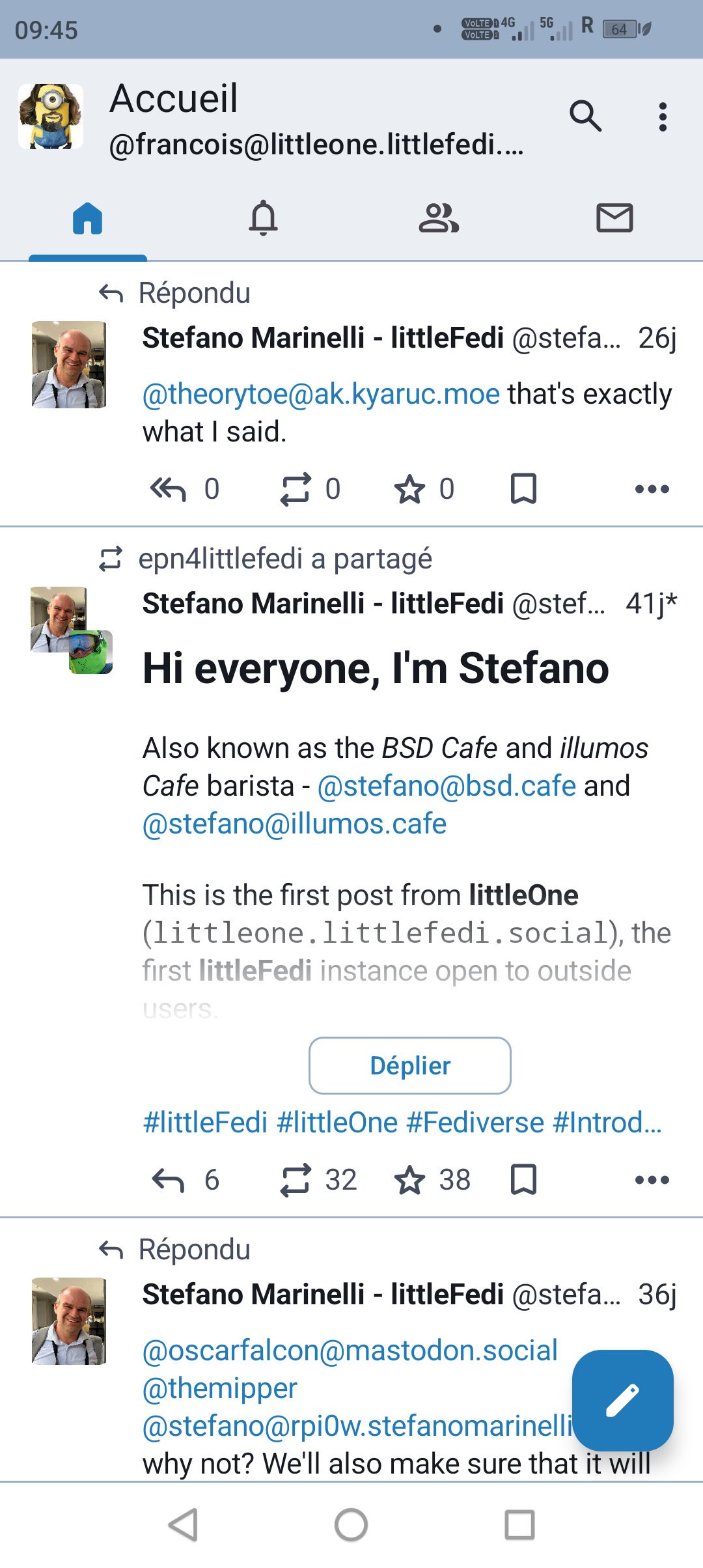
@stefano Home didn’t work with littlefedi on ice Cubes and local and federated had wrong timestamps. Now home works and timestamps show right timing. Saying goodbye to Ivory…

@stefano I am testing now. Re-added the little account on IceCubes. Earlier the error took a while to appear. Keeping my eyes open.
@francois still showing issues? I tested it on my devices and it's working. Which error are you experiencing?
Hello!
I've just pushed a new build and it should fix the Icecubes (on iOS) and Tusky (on Android) compatibility issues. If you were affected, could you please test?

"All Civilisations Fall. Ours is Special Though, Obviously.
Why I’m 100% Doom, 100% of the Time"
https://adrianlambert.substack.com/p/all-civilisations-fall-ours-is-special
#AdrianLambert #EarthOvershoot #Civilization #Collapse #Doom
"Civilisations are material systems organised around energy. Their scale, complexity, and population reflect how much energy is available and how it is structured. When the energy available can no longer sustain that level of organisation, contraction follows.
We are not running out of energy. We are losing the ability to organise it.
Stability reflects continuous energy throughput, not permanence.
This is why all civilisations collapse.
It is built in.
What varies is the distance between the peak of the civilisation and the conditions that remain after decline.
(...)
"The World Isn’t Ending. It’s Stopping Working.
(...)
To see this clearly, the essay moves through three cases: early agrarian civilisation in Mesopotamia, the imperial system of Rome, and modern industrial civilisation."
https://adrianlambert.substack.com/p/the-world-isnt-ending-its-stopping
"Neurodivergent advocacy in a collapsing society has to extend beyond supporting inclusion in the world as it was. It has to become part of building the forms of life that remain possible as that world begins to fail."
"Masked Twice: Neurodivergent Advocacy in a Collapsing Society
What happens when neurodivergent people are asked to fit into systems that are starting to fail?"
https://adrianlambert.substack.com/p/masked-twice-neurodivergent-advocacy
#AdrianLambert #Neurodiversity #Society #Collapse #Inclusion
"Cities are Intensive Livestock Systems, and Humans are the Cattle
You are more dependent than you think.
Chapter 1: The City Is Not an Escape from Ecology
We do not think of ourselves as livestock - not the way we think of pigs, sheep or cows. But perhaps we should, and the place to start is where most of us live.
Cities are the ecological equivalent of intensive livestock systems for Homo sapiens.
That may sound extreme, because modern culture has trained us to see cities as evidence of human advancement. The city is where humanity supposedly became civilised. It is where we conduct and celebrate culture, politics, finance, medicine and technology, and tell ourselves that we have risen above the constraints of land, soil, weather and food.
That interpretation mistakes abstraction for ecological transcendence.
Humans do not escape ecology by building cities. Through cities, we reorganise ecological dependence into forms that are invisible to us in our daily lives.
Ignorance by design.
A feedlot concentrates animals in a simplified artificial environment. Their food is produced elsewhere. Their waste becomes a technical problem. Their movement is constrained. Their bodies are reorganised around production and output.
The modern city concentrates human bodies at high density, imports energy and biomass from elsewhere, converts those flows into economic activity and waste, and presents the arrangement as civilisation.
Feedlots and cities perform the same function for different species.
(...)"
https://adrianlambert.substack.com/p/cities-are-intensive-livestock-systems