#genai
It is said that ai generated websites would all look the same.
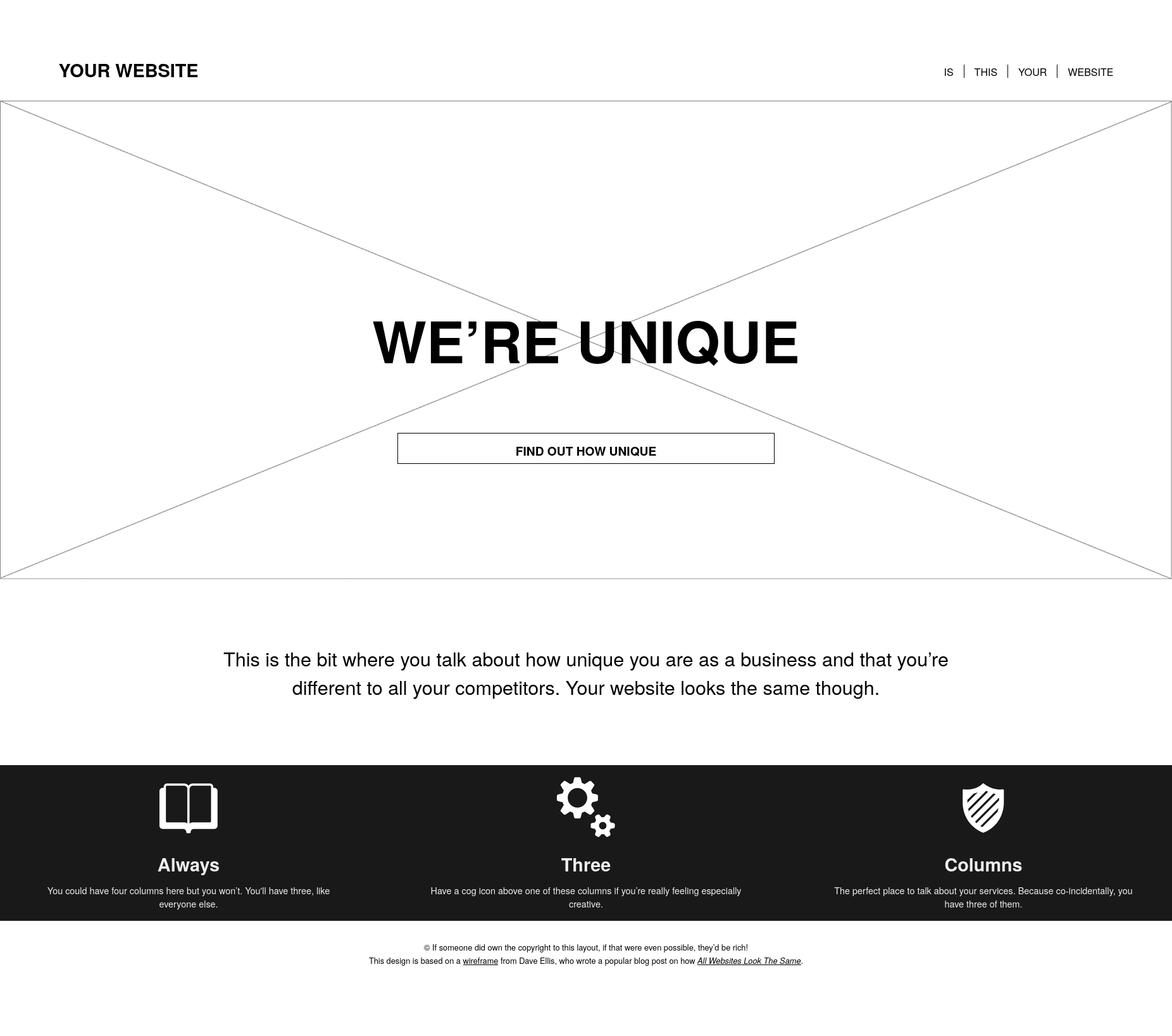
Well, like @jensimmons@front-end.social pointed out already in 2017 is that indeed many business websites looked the same anyway:
- logo top left
- horizontal navigation
- big "hero"-image beneath
- large introduction with a "call to action"-button above the fold
- three columns for the most important things to point out
- and so on.
So unique, isn't it?
And nowadays?
Even without the rise of ai generated websites this trend only got going, as this layout is the mostly used on the internet.
The "commercialised internet" developed speficic conventions and shaped user expectations, like e.g. for onlineshops:
- logo top left or centered
- search bar top center or right
- user navigation top right (like profile, basket)
- product image(s) on the left, "buy"-button right
- and much more.
And we, as users, are deeply conditioned to these layouts.
So, what's the big deal, if ai generated websites "all look the same"?
Isn't all just a remix anyways?
"What could we make with AI if scale wasn't an objective?
The Small AI chapter invites us to rethink AI not as something floating in “the cloud,” but as deeply entangled with land, ecologies, and people — showing how technology can prioritize community value in design and governance. From artists building their personal AI models to citizen scientists preserving marginalized languages, the chapter highlights the power of small-scale approaches to protecting cultural heritage and supporting ecological resilience."
--
Intersting project!
"Image poisoning" with Nightshade - a handy tool for anyone, who publishes photos and graphics of their artworks online.
Description (excerpt):
"Nightshade works similarly as Glaze, but instead of a defense against style mimicry, it is designed as an offense tool to distort feature representations inside generative AI image models. Like Glaze, Nightshade is computed as a multi-objective optimization that minimizes visible changes to the original image. While human eyes see a shaded image that is largely unchanged from the original, the AI model sees a dramatically different composition in the image. For example, human eyes might see a shaded image of a cow in a green field largely unchanged, but an AI model might see a large leather purse lying in the grass. Trained on a sufficient number of shaded images that include a cow, a model will become increasingly convinced cows have nice brown leathery handles and smooth side pockets with a zipper, and perhaps a lovely brand logo.
As with Glaze, Nightshade effects are robust to normal changes one might apply to an image. You can crop it, resample it, compress it, smooth out pixels, or add noise, and the effects of the poison will remain. You can take screenshots, or even photos of an image displayed on a monitor, and the shade effects remain. Again, this is because it is not a watermark or hidden message (steganography), and it is not brittle. (...)"
--
"What Is Nightshade?Why Does It Work, and Limitations"
https://nightshade.cs.uchicago.edu/whatis.html
#Nightshade #Glaze #Photography #Art #Artist #Artwork #Image #ImagePoisoning #genAI