Local timeline


Today’s littleFedi updates:
- Strengthened allowlist-only federation: redirects, discovery, deliveries, and hostname handling now consistently respect the policy. (Spoiler alert: there's a reason behind this 😉)
- Fixed boosts for local-only posts, plus a timeline relative-time refresh issue.
- Fixed an Android PWA green-bar issue by letting the manifest update normally.
- Disabling remote media caching now safely clears leftover cache jobs instead of leaving the queue unhealthy.

@randahl@mastodon.social
How many of viewers came from Sharkey, Friendica, Hubzilla, Pixelfed and the many more Fediverse software?
It's not only Mastodon.
You know!?


@stefano
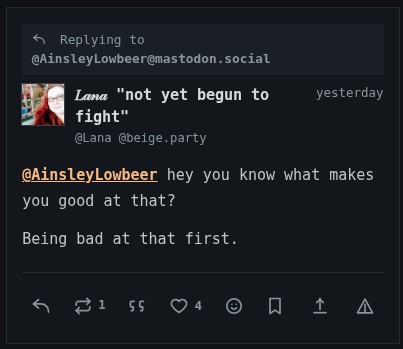
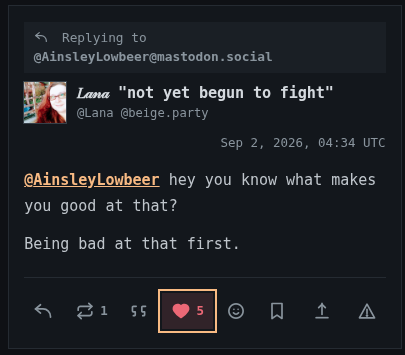
Just noticed a "funny" behaviour:
In desktop browser, if the window is narrow (like with Vivaldi's "Tile Tabs"-feature) and I interact with a post (like or boost), the date switches from "yesterday" to "Sep 2, 2026, 04:34 UTC", and after a few seconds, back to "yesterday".
Is that intended behaviour?
--
Can anyone confirm this behaviour in their browser?
--
Edit:
This post is "Local only", however I could boost it?
Would it therefore change visibility to "Public"?
@anatudor@mastodon.social
Just use a language that doesn't make use of any articles ;)
Like e.g. Lingwa de Planeta (Lidepla).
http://lingwadeplaneta.info
https://lidepla.net
(the latter designed by me)
Zine Exchange Club
"Connect with fellow photography zine makers and exchange your creations with enthusiasts around the world."
Interesting idea as well :)
Postcard Exchange Club
"Connect with fellow photography postcard makers and exchange your creations with enthusiasts around the world."
I like this idea! :)

There are 48 local accounts on this instance.
It may not be extremely active, but SQLite is handling the workload very well. The load is currently close to zero, even though littleFedi is running on a cheap VPS with 2 cores and 4 GB of RAM. It handles federation, lazy media caching, housekeeping and the usual background work
while using around 600 MB of RSS.
That figure represents the whole process footprint - not just the post cache - and includes the Go heap, reusable allocations, buffers and SQLite memory mappings.
When an incoming post is relevant to a local user, littleFedi inserts it into that user’s materialized home feed in SQLite at ingest time. Opening the home timeline therefore requires an indexed read instead of rebuilding it from follows and followed hashtags. A bounded in-memory cache also keeps hot entities, timeline windows and rendered pages ready, while a background warmer refreshes the timelines of recently active users.
Cache misses, restarts and evictions still fall back to SQLite, but the normal warm path is very fast. The bubble timeline also uses the cache, although its cold database path still needs quite a bit of work.
For comparison, my single-user instance on a Raspberry Pi Zero 2 W uses around 60 MB of RSS a few seconds after browsing around.
Go’s garbage collector runs automatically and reclaims unreachable heap objects. Some memory may remain reserved for reuse, however, so RSS does not necessarily fall immediately after a collection cycle.
littleFedi isn’t trying to compete with snac on minimalism - snac is awesome and remains the best solution for many scenarios. The goal is to offer a different experience while remaining usable across a wide range of hardware platforms and operating systems.


Anyone liking musicals, yes?
Have you seen "Newsies" already?
It's a great show, imho, and there are some full show recordings on youtube.
It's about the "Newspaper Boy Strike" in New York, in the 1890's.
Very entertaining, with great actors and music.
(And I wonder, which of today's "movements" will be performed as a musical in a hundred years time? 🤔)
Watch it here:
https://inv.nadeko.net/ZuDNyiZBdyM
@abuerkl@literatur.social
Hmm, in meinem Firefox ohne JavaScript sehe ich nur eine große schwarze leere Seite. 🤷
@@nick_lenzen@fosstodon.org