Local timeline

See me surprised! (not) 🙄
 @hkrn@mstdn.social
AI is hitting entry-level jobs hardest, Stanford study finds
L: https://arstechnica.com/ai/2026/08/ai-is-hitting-entry-level-jobs-hardest-stanford-study-finds/
C: https://news.ycombinator.com/item?id=49435147
posted on 2026.08.25 at 10:48:58 (c=1, p=5)
@Nux@fosstodon.org I've implemented it on MastoBlaster, using on device Apple Intelligence, but the result is...terrible, at least for now.
In general, I'd avoid to depend on external services for this: you need to use APIs, etc.
Thank you for the suggestion!

@stefano
It's a real pleasure to see this wonderful vision getting into shape (and being a part of it).
Thank you very much! 🤗
@stefano thanks team #littlefedi. Gives me plenty of time to get my own house in order prior to install
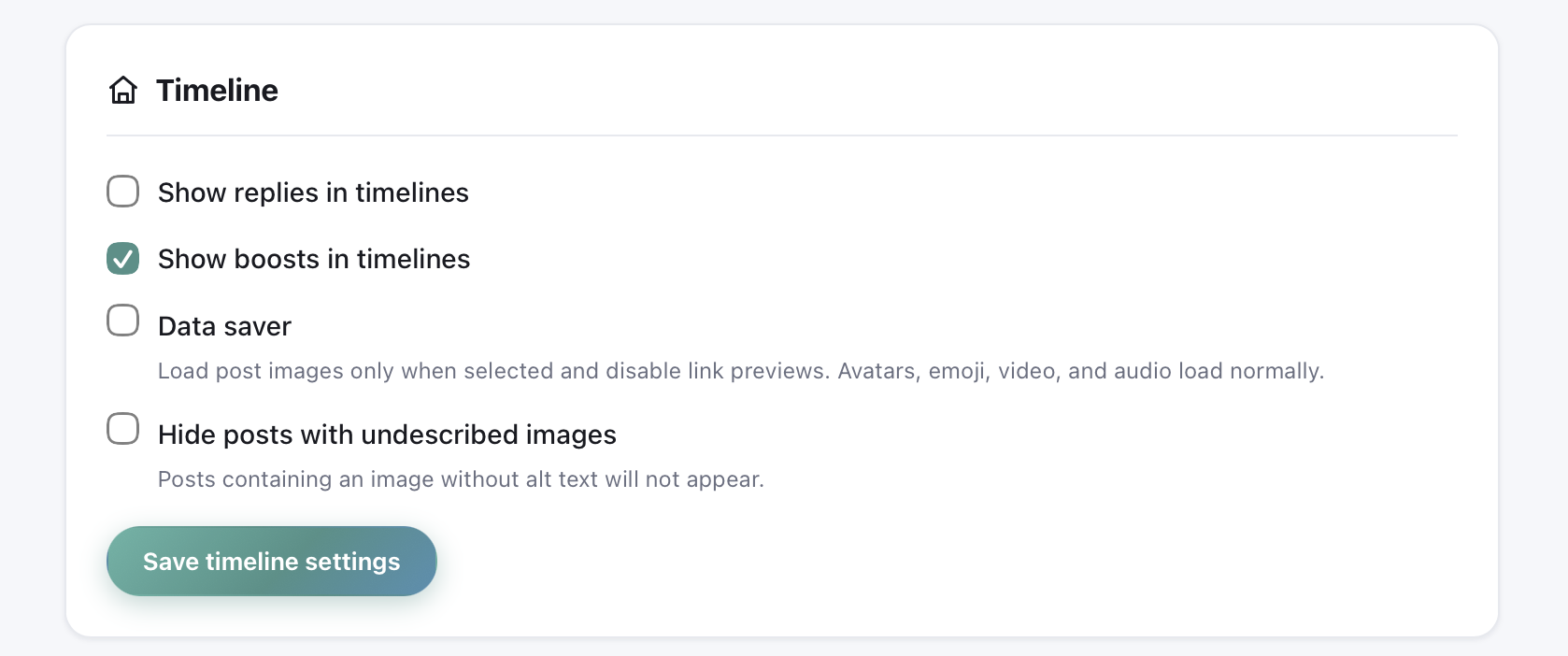
littleFedi allows you to hide all posts that have images without alt text.
Because yes, that's how it should be.


@stefano nice to have a timeline for release, looking forward to poking at the self hosted instance, reporting, and maybe even contributing (probably beyond my very rudimentary Go skills). Good luck team!
The plan was to release the source code for #littleFedi before the end of the month, but #EuroBSDCon takes place shortly after and I'll be quite busy.
Since the first few days post-release are always the most dynamic, the plan now is to release it right after (shortly after 15 September), allowing a few more weeks for bug fixes, tweaks, integrations, etc., that the wonderful people on this instance are sending in day after day.
To all of you: thank you!
"The internet isn't in the cloud. It lives at an address.
We went looking for where each URL lives IRL. Turns out it's not one address but many. r00ts traces your browsing to the data centers behind it, the real buildings where your internet actually lives.
(...)
Every video you stream, feed you scroll, website you visit comes from a place, a building, a data center. It has an address. It sits on someone's land, draws power from a specific grid, and pulls water from local reservoirs, with real people living right next to it. This isn't a secret. Researchers and journalists are documenting it medium-well. But that documentation sits conceptually far from how we use the internet every day. r00ts brings those investigations closer, rooting your everyday browsing to the data center that powers it.
(...)
r00ts is a free, open-source extension for Chrome and Firefox that traces the page you're on to the data centers likely serving it. Open any site, click the r00ts icon, and it follows that page's requests to their IP addresses, then to the networks and facilities behind them. For each one, we show our work, the clues we followed to land on that specific building, so you can run the same kind of investigation yourself. Some sit near(ish) you; some are a world away. It collects nothing about you: no accounts, no cookies, no logs. It's not in the Chrome or Firefox stores yet, so for now it's a manual install."
https://aixdesign.co/projects/r00ts
#r00ts #Internet #DataCenter #Tracking #Location #Browser #BrowserExtension #Firefox #Chrome
"What could we make with AI if scale wasn't an objective?
The Small AI chapter invites us to rethink AI not as something floating in “the cloud,” but as deeply entangled with land, ecologies, and people — showing how technology can prioritize community value in design and governance. From artists building their personal AI models to citizen scientists preserving marginalized languages, the chapter highlights the power of small-scale approaches to protecting cultural heritage and supporting ecological resilience."
--
Intersting project!
"Decolonize.Digital is an online resource that is a living, growing, and evolving website bringing together different connected projects that I've been working on. Parts of the site are available to all subscribers, but parts of it require a paid subscription. I made this decision because I've put hours, weeks, and months into this tool, in addition to my decades of work and learning that even makes creating it possible. I regard this work as I would a book, workshop, or any other labor that I do that is part of my life's work.
For free subscribers to my platform liberationtoolbox.io, all of these posts, articles, videos, and various mediums have been made available across my many platforms over the many years for free. And they are still accessible to all through those different platforms.
There are people who have the gall to be upset that I am actually compensated for my labor. If this is you, you should not be here. I do not recommend that you subscribe to the free or paid options of this Liberation Toolbox if you are one of these people.
Currently, on this site, Decolonize.Digital, I have put up the De-Google Your Life (Decentering Big Tech) series, Buildsheet: Community Building series, and the Opt-Out series. I will continue adding tools to each of these series over time. I have some exciting series and tools coming up.
Why now? Why this? When wielded by oppressors, everything, including technology, becomes murderous and rapacious, it becomes digital colonization.
There are better ways for technology. Finding these other liberatory ways, this is my life's work, to Decolonize Digital."
https://decolonize.digital
https://liberationtoolbox.io
#DecolonizeDigital #DIT #DUT #DUTgemacht #DigitalSovereignty #OpenSource #FOSS
@daisy 1. this should have been fixed
2. there was no setting: the server always reports the absolute time, then the javascript code makes it relative. Now there's a setting but it's "per client", so if you use two browsers, they may have different settings.
Thank you for your help!
QUILI.AI
"A town becomes AI for a day in a bid to save its water.
An initiative by FUNDACIÓN AVINA and CORPORACIÓN NGEN.
[The Problem]
Quilicura, Chile sits within the Maipo river basin, one of the main sources of water for people and farming. Since the early 2010s, Quilicura has become a major hub for A.I data centers that use large amounts of water to cool down servers. Because of that, coupled with an ongoing climate crisis, Chile is facing a severe drought expected to last until 2040.
[Becoming AI for a Day]
Even though A.I. can move mankind ahead, the irresponsible use of A.I. can have disastrous effects on our water and other resources. It is inconceivable to think that someone casually using A.I. to create funny images in NYC or Berlin, can affect the water supply in Quilicura, Chile.
To make the impact visible, and to help draw visibility to the problem, the residents from Quilicura became “human A.I.,” for a day. Answering prompts, creating content with local artists, and completing other tasks manually.
Humans helping to answer prompts
The initiative helped dimensionalize a complex problem, and helped show the world the real people affected by the the irresponsible use of A.I. and the hidden cost it has on local water resources.
[THE IMPACT]
25,000 prompts
On JAN 31st from 8 AM to 8 PM: more than 40 people from Quilicura managed to answer more than 25,000 prompts.
(...)
Each chat lasted an average of 11’ 4.
68 COUNTRIES
Chatting with more than 68 countries around the world that supported the project.
(...)
71.6 M
was the global reach in just one day.
+1 BILLION
The initiative managed to reach more than 1 billion people in the world.
Thank you for helping us save our water."
#QuiliAI #Quilicura #Chile #AI #analogAI #Chatbot #NYC #Berlin
@stefano
Ah, oh, sorry, thanks a lot!
(ok i'll wait how it develope. Found a good example in the same thread but hope I'll not need it. 😉 https://freiburg.social/users/stevE/statuses/117138510219194916 ) 🤗
@francois
"Image poisoning" with Nightshade - a handy tool for anyone, who publishes photos and graphics of their artworks online.
Description (excerpt):
"Nightshade works similarly as Glaze, but instead of a defense against style mimicry, it is designed as an offense tool to distort feature representations inside generative AI image models. Like Glaze, Nightshade is computed as a multi-objective optimization that minimizes visible changes to the original image. While human eyes see a shaded image that is largely unchanged from the original, the AI model sees a dramatically different composition in the image. For example, human eyes might see a shaded image of a cow in a green field largely unchanged, but an AI model might see a large leather purse lying in the grass. Trained on a sufficient number of shaded images that include a cow, a model will become increasingly convinced cows have nice brown leathery handles and smooth side pockets with a zipper, and perhaps a lovely brand logo.
As with Glaze, Nightshade effects are robust to normal changes one might apply to an image. You can crop it, resample it, compress it, smooth out pixels, or add noise, and the effects of the poison will remain. You can take screenshots, or even photos of an image displayed on a monitor, and the shade effects remain. Again, this is because it is not a watermark or hidden message (steganography), and it is not brittle. (...)"
--
"What Is Nightshade?Why Does It Work, and Limitations"
https://nightshade.cs.uchicago.edu/whatis.html
#Nightshade #Glaze #Photography #Art #Artist #Artwork #Image #ImagePoisoning #genAI